.png)
AI Governance & Strategy
Build AI Into Your Business Without Losing Control
AI is reshaping every industry. But without a governance framework, it introduces real liability. Framework helps you adopt AI confidently — with strategy, policy, and oversight built in from day one.
Protecting over $20B in assets nationally


The Problem
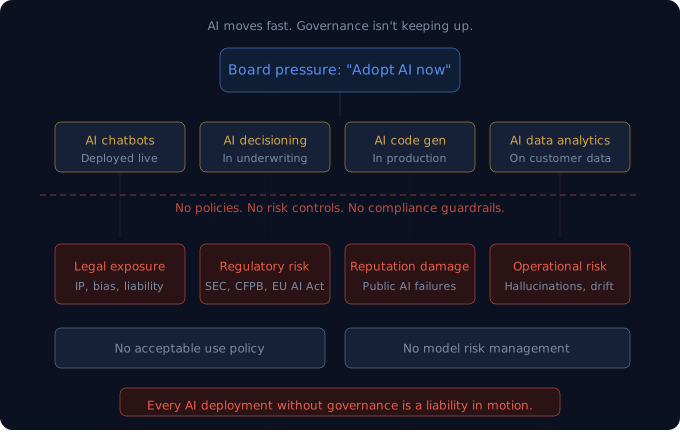
AI Moves Fast. Most Businesses Aren't Ready for It
Executives are under pressure to adopt AI — but few have policies, risk controls, or compliance guardrails in place. That gap creates exposure: legal, regulatory, reputational, and operational.
The Solution
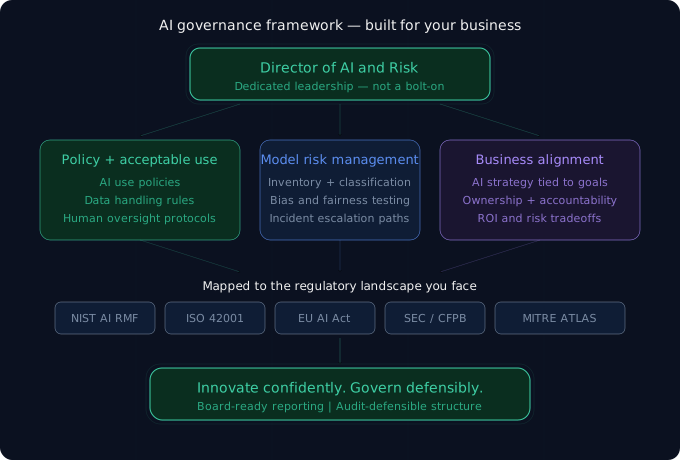
An AI Governance Framework Built for Your Business
Framework's AI Strategy and Governance practice — led by a dedicated Director of AI and Risk — helps organizations define acceptable use, manage model risk, and align AI adoption with business goals.

Clarity Before Action
Security decisions made without visibility are just guesses. We build a precise picture of your risk landscape first — so every recommendation we make is grounded in your reality, not a generic playbook.
Confidence Under Pressure
When an incident strikes or an audit looms, preparation is everything. We ensure your team knows exactly what to do, with the tools, plans, and expertise to respond with speed and control.
Security Built for Growth
Your business doesn't stand still — and neither does your threat landscape. Our programs are built to evolve alongside you, delivering lasting protection as your organization scales, pivots, and advances.
Benefits
What You Get With Framework's AI Governance Practice
From AI use policies to regulatory alignment and board-ready reporting, our team delivers the structure to innovate responsibly — and the confidence to show stakeholders you're in control of AI risk.
Clearer Security Visibility
Stop guessing about your posture. Get a measurable, documented view of where you stand and what's changing.
Expert Help, No Overhead
Access senior security expertise on demand, without the cost or complexity of building an in-house team.
Faster Incident Response
Know exactly what to do when something goes wrong — with plans, playbooks, and support already in place.
Reduced Risk Exposure
Identify and close gaps before attackers find them — systematically lowering your organization's attack surface.
Compliance Confidence
Stay ahead of evolving frameworks (SOC 2, HIPAA, CMMC, etc.) with guidance built into every engagement.
Stronger Partner Trust
Demonstrate security maturity to clients, partners, and regulators — turning compliance into a competitive advantage.
Testimonials
What executives are saying
"Navigating AI regulation is a moving target. Framework Security provided the deep regulatory expertise and proactive guardrails we needed to innovate without exposing Lender Toolkit to unnecessary risk."
Jeff Neuman
SVP, AI Data & Engineering
Lender Toolkit
Lender Toolkit
"Framework Security establishes a seamless workflow. The team is attentive, communicative, and pragmatic."
Aaron Scruggs
CEO
Rephyr
Rephyr
"I wish I had found Framework before speaking with any other companies."
Ben Londa
President & CEO
Volo Solutions
Volo Solutions
How it Works
Get started in 3 simple steps
Get started with FWS in just three simple steps.
Step 1
Book a call
Start by booking a call with our team to identify your gaps in real-time.
Book a call
Step 2
Get your gap assessment
See exactly where your gaps and are what exactly needs improved.
Book a call
Why Companies choose Framework security
Protecting over $20B in assets nationally
Leadership Experience | 65+ years of combined team experience across real enterprise environments, not junior analysts overseen from a distance. |
No Vendor Independence | Completely vendor-agnostic. Every recommendation is based solely on what reduces your risk, no preferred partnerships influencing the advice. |
Compliance Philosophy | Frameworks are treated as living tools that scale with your business, not static checklists built to pass audits and collect dust. |
Executive Access | vCISO services give you direct access to senior security leadership, bridging the gap between board-level priorities and technical execution. |
Pricing & Value | Partner pricing passed directly to clients. Purpose-built for mid-market organizations that need enterprise-grade security without enterprise-grade overhead. |
Third-Party Recognition | Clutch #1 in North America, G2 Top 10, AWS Marketplace top pen testing provider, Gartner Peer Insights listed, validated across multiple independent platforms. |
Case Studies
Done-for-you compliance
Explore how we're helping companies become, and stay, both secure and compliant.

%201.png)



Frequently Asked questions
Some common questions we get
Still have a question? Email us at contact@frameworksecurity.com
Who is this checklist for?
It is written for fintech executives, CISOs, CTOs, and risk and compliance leaders who are deploying or evaluating AI tools and need a governance framework that can hold up to regulatory scrutiny.
How long does it take to complete?
Most people work through it in 15 to 20 minutes. You can also complete it in sections if you need to pull in input from your IT team.
What do I do after I complete it?
The checklist is designed to give you a clear picture of where you stand. If you find gaps you want help addressing, Framework Security offers advisory services ranging from a single consultation to ongoing Virtual CISO support. There is no obligation to engage further.
Is this checklist specific to a particular regulation or framework?
It draws on requirements and guidance from the CFPB, SEC, ECOA, Reg B, NYDFS, and MITRE ATLAS. It is designed to be broadly applicable across the fintech regulatory landscape rather than narrowly tied to a single rule.
Do I need a technical background to use this?
No. The checklist is written for executive decision-makers. Some sections reference technical controls, but the focus is on organizational accountability, governance structure, and defensible decision-making.
What does Framework Security do?
Framework Security is a cybersecurity advisory firm specializing in AI governance, virtual CISO services, compliance, and risk assessments. We work with finance, technology, and healthcare organizations that need expert guidance without the overhead of a large consultancy. Our team brings over 65 combined years of fintech experience, led by a former CISO/CIO.
Get Started
Let's work together
Tell us about yourself and we’ll figure out the best solution for you and your organization's needs.


