

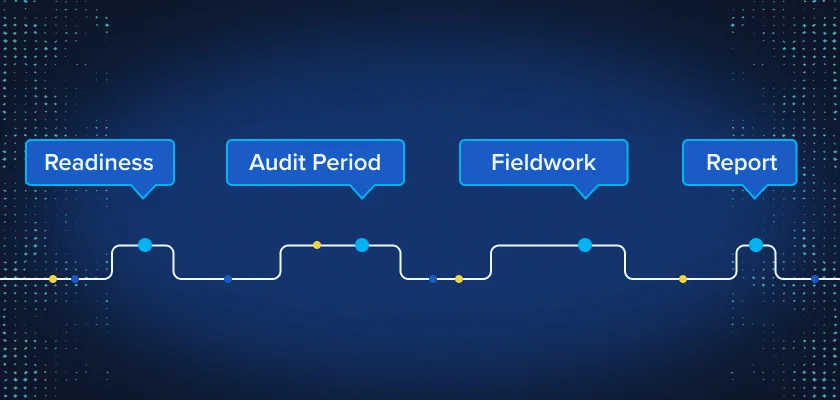



For organizations beginning their SOC 2 journey, one of the first questions is usually:
"How long does SOC 2 compliance take?"
The short answer: it depends on your organization's security maturity, the type of SOC 2 report you pursue, the complexity of your environment, and how quickly you can implement and demonstrate required controls.
A company with mature security practices, documented policies, and existing compliance processes may complete SOC 2 preparation in a few months. A growing SaaS company building its security program from the ground up may need six to twelve months or longer.
SOC 2 is not simply an audit. It is the process of building, documenting, operating, and proving that your security controls work effectively.
This guide explains realistic SOC 2 timelines, the factors that impact completion time, the difference between Type 1 and Type 2 timelines, and how organizations can accelerate the process.
Average SOC 2 Timeline Overview
While every organization is different, most companies follow a similar SOC 2 compliance journey.
PhaseTypical TimelineReadiness assessment2–6 weeksGap remediation1–6 monthsPolicy development2–8 weeksTechnical control implementation1–6 monthsEvidence collection3–12 monthsSOC 2 Type 1 audit2–6 weeksSOC 2 Type 2 audit3–12 month observation period + audit
For organizations pursuing their first SOC 2 report, the entire process commonly takes:
- SOC 2 Type 1: Approximately 3–6 months
- SOC 2 Type 2: Approximately 6–12+ months
Organizations with significant security gaps may require additional time.
Understanding the SOC 2 Compliance Process
SOC 2 timelines are driven by several major phases.
Phase 1: SOC 2 Readiness Assessment
Typical timeframe: 2–6 weeks
The first step is understanding where your organization currently stands.
A readiness assessment evaluates your existing security practices against SOC 2 requirements and identifies gaps that need to be addressed before the audit.
During this phase, organizations typically review:
- Security policies
- User access controls
- Infrastructure security
- Vendor management
- Incident response processes
- Risk management
- Logging and monitoring
- Vulnerability management
The result is a roadmap outlining what needs to be completed before the audit.
Organizations that skip this phase often encounter unexpected delays because they discover gaps after the audit process has already started.
Phase 2: Implementing SOC 2 Controls
Typical timeframe: 1–6 months
After identifying gaps, organizations begin implementing the necessary security controls.
The timeline depends heavily on how mature the company's security program already is.
Common activities include:
Identity and Access Management
Examples:
- Implementing MFA
- Configuring SSO
- Reviewing user permissions
- Establishing onboarding/offboarding procedures
- Managing privileged accounts
Security Policies
Organizations typically develop or update policies such as:
- Information Security Policy
- Access Control Policy
- Incident Response Policy
- Vendor Management Policy
- Business Continuity Policy
- Change Management Policy
Vulnerability Management
Organizations may need to establish:
- Vulnerability scanning processes
- Patch management procedures
- Remediation workflows
- Security testing processes
Monitoring and Logging
Companies may need to improve:
- Centralized logging
- Security alerting
- Log retention
- Monitoring procedures
The more security infrastructure already exists, the faster this phase typically moves.
Phase 3: Evidence Collection
Typical timeframe: 3–12 months
Evidence collection is one of the biggest differences between Type 1 and Type 2 audits.
SOC 2 auditors do not simply review whether policies exist. They need evidence that controls are operating effectively.
Examples of evidence include:
- User access reviews
- Security awareness training records
- Vulnerability scan reports
- Penetration testing reports
- Change management records
- Incident response exercises
- Vendor assessments
- System monitoring logs
For Type 2 audits, organizations must demonstrate that these controls operated consistently throughout the audit period.
This is why Type 2 reports generally take significantly longer.
How Long Does SOC 2 Type 1 Take?
A SOC 2 Type 1 report is typically faster because it evaluates controls at a specific point in time.
A realistic timeline:
Fast Timeline: 2–3 Months
Possible when:
- Security controls already exist
- Policies are documented
- Technology is already implemented
- The company has compliance experience
Typical Timeline: 3–6 Months
Common for growing SaaS companies that need to strengthen security controls before the audit.
Longer Timeline: 6+ Months
Likely when organizations need significant improvements in areas such as:
- Access management
- Security monitoring
- Policies
- Vulnerability management
- Incident response
Type 1 can be a good starting point for companies that need to demonstrate security maturity quickly.
How Long Does SOC 2 Type 2 Take?
SOC 2 Type 2 requires an observation period where auditors evaluate whether controls operate consistently over time.
This makes the timeline longer.
A typical Type 2 process:
Preparation Phase
2–6 months
Organizations implement controls and establish evidence collection processes.
Observation Period
3–12 months
The auditor evaluates control performance over the selected period.
Common observation periods:
- 3 months: Faster option
- 6 months: Common approach
- 12 months: Strongest assurance
Audit Completion
Several weeks
The auditor reviews evidence, performs testing, and prepares the final report.
A realistic end-to-end Type 2 timeline is usually:
6–12 months.
Factors That Impact SOC 2 Timeline
Several factors determine how quickly an organization can complete SOC 2.
Company Size
Larger organizations generally require more time because they have:
- More employees
- More systems
- More vendors
- More complex environments
- More access controls
A 20-person SaaS startup may complete preparation faster than a 500-person organization with multiple products.
Security Maturity
Security maturity is often the biggest factor.
Organizations that already have:
- MFA
- Endpoint protection
- Security policies
- Vulnerability management
- Logging
- Incident response procedures
can move much faster.
Companies starting without formal security processes may need months of foundational work.
Existing Compliance Tools
Compliance automation platforms can accelerate evidence collection and workflow management.
Common platforms include:
- Drata
- Vanta
- Secureframe
- Thoropass
These tools can help automate:
- Policy management
- Evidence collection
- Employee tasks
- Control monitoring
However, they do not automatically create security controls.
A compliance platform can collect evidence that MFA is enabled, but it cannot implement MFA, fix vulnerabilities, or build an incident response program.
Scope of the Audit
The larger the audit scope, the longer the process.
Factors include:
- Number of products
- Cloud environments
- Applications
- Employees
- Third-party vendors
- Data types handled
Reducing unnecessary scope can significantly simplify the process.
Evidence Gaps
Many organizations underestimate how much historical evidence auditors require.
Common evidence gaps include:
- Missing access reviews
- Incomplete employee training records
- No documented change approvals
- Lack of vulnerability remediation tracking
- Missing vendor reviews
Building evidence collection processes early helps avoid delays.
How to Speed Up SOC 2 Compliance
Organizations can reduce their timeline by taking a structured approach.
Start With a Readiness Assessment
Understanding gaps before beginning the audit prevents wasted effort.
Prioritize High-Impact Controls
Focus first on areas auditors and customers care about most:
- MFA
- Access management
- Vulnerability management
- Logging
- Incident response
- Security policies
Use Automation Where Appropriate
Compliance tools can reduce administrative overhead and improve evidence tracking.
Work With Experienced Security Partners
A security partner can help accelerate:
- Gap assessments
- Policy development
- Technical remediation
- Penetration testing
- Audit preparation
Avoid Treating SOC 2 as a Documentation Project
The fastest SOC 2 programs are those that build real security capabilities rather than simply creating documents.
Common Reasons SOC 2 Projects Get Delayed
Organizations commonly experience delays because of:
Waiting Too Long to Start
Many companies begin SOC 2 preparation only after a customer requires a report.
This creates unnecessary pressure.
Lack of Internal Ownership
SOC 2 requires coordination across:
- Engineering
- IT
- HR
- Leadership
- Operations
Without clear ownership, progress slows.
Insufficient Technical Controls
Policies alone are not enough.
Organizations may need time to implement:
- Security monitoring
- Access controls
- Vulnerability management
- Endpoint security
Starting the Audit Too Early
Beginning an audit before controls are operational often results in findings and delays.
SOC 2 Timeline: Final Thoughts
So, how long does SOC 2 compliance take?
For most organizations:
- SOC 2 Type 1: 3–6 months
- SOC 2 Type 2: 6–12+ months
The timeline depends on your organization's existing security posture, audit scope, available resources, and ability to consistently operate security controls.
The companies that complete SOC 2 most efficiently are those that treat it as a security improvement initiative—not just an audit requirement.
By starting with a readiness assessment, implementing the right controls, and establishing repeatable security processes, organizations can achieve SOC 2 compliance while building a stronger foundation for long-term growth.
Framework Security helps organizations prepare for SOC 2 by identifying security gaps, implementing technical controls, performing penetration testing, and developing security programs aligned with customer and compliance requirements.


Talk With A Cybersecurity Expert
Bring the deadline you're staring at, the framework you're being held to, and the team you have. In 30 minutes we'll tell you honestly whether we're the right fit — and if we are, what the first two weeks look like.
Book a working session